Description
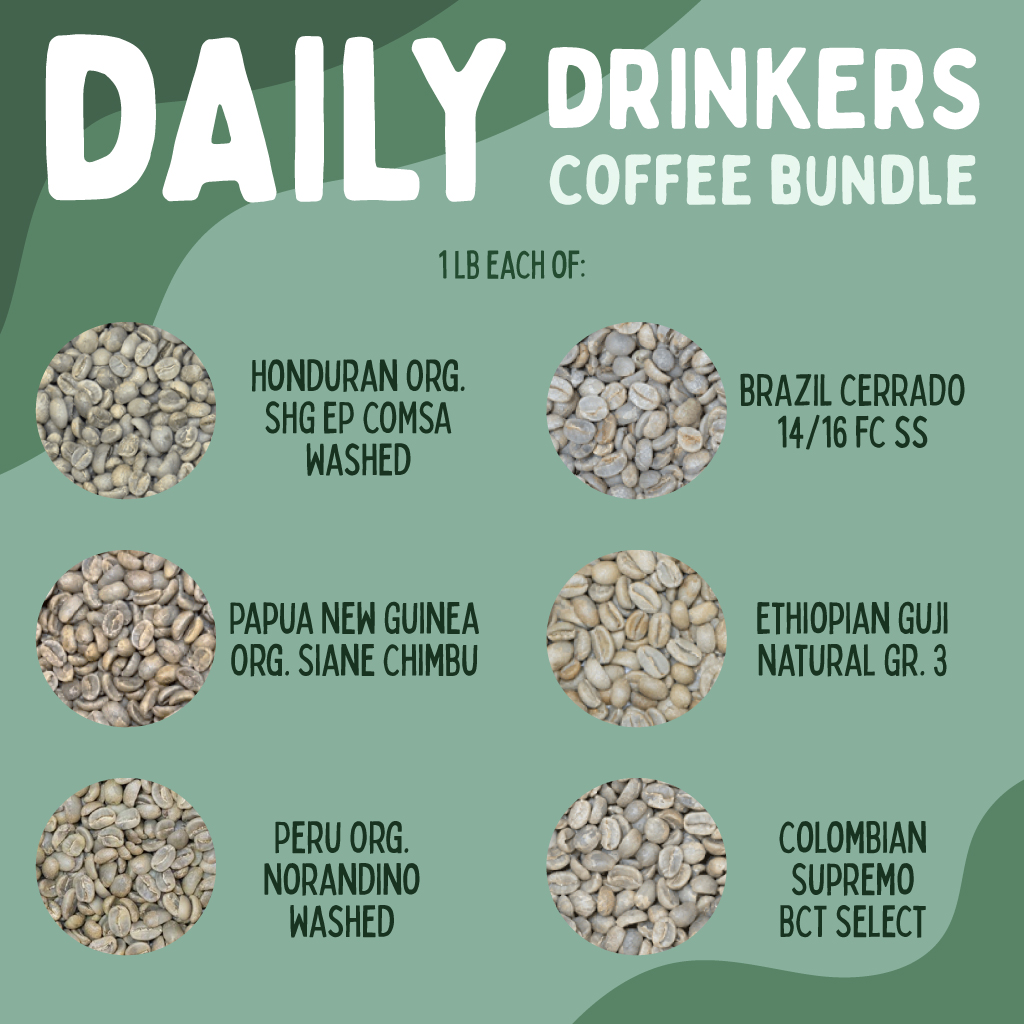
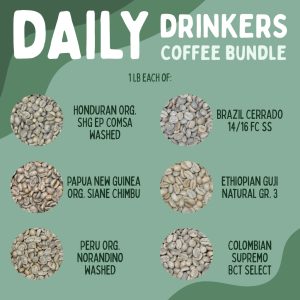
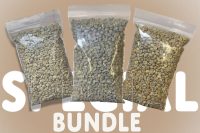
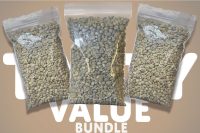
This bundle features six fresh coffees, some of our favorite daily drinkers, each at an incredible price. Only $6.40/lb with this bundle!
One pound each of:
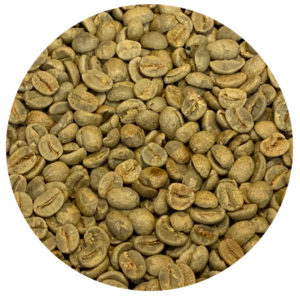
As the world’s largest coffee producer, Brazilian lots often come in larger sizes with regional names. So, it becomes extremely helpful to understand regional nuances. The Cerrado region, the newest of three major Brazilian growing regions, has been building in reputation and production over the last few decades. Located between São Paulo and Brasilia, coffee in this region is grown on high plateaus at elevations peaking just over 1,000 meters above sea level. The region also has relatively mild weather patterns providing a more predictable climate for processing coffee. Cerrado lots frequently come from large suppliers that use highly mechanized processing strategies to manage larger volumes. When the coffee is milled for export, the green beans are sorted by screen size and graded according to size and then cupped for quality. Our current offering is 14/16 bean size, on the medium to small side, Fine Cup (FC) and Strictly Soft (SS), the highest cup category in the Brazilian coffee grading system.
Tasting Notes: The aroma is very nutty and sweet. There was a surprising hint of smoke on the palate. Full bodied and low acidity, best at medium to dark roasts – this is a traditional tasting Brazil – thick, creamy, nutty and semi-sweet. At the darker roasts a very sweet first taste, almost a little fruity, and then quickly turns darker-toned with a bakers chocolate and slightly toasted walnut flavor. Great blend base for espresso or adding body with darker tones although many will love it as an single origin drinker.
Roasting Notes: A pretty versatile bean, although we wouldn’t recommend a light roast. Medium roast will be smoother and more neutral tasting. A darker roasted will bring out the smoky and chocolate notes that most will shoot for. This would be a great bean for blends.
A multi-region aggregate production coffee mean to produce “Classic” Colombian features. Low acidity, good body, with nutty/chocolate/spice like tones.
In Colombia the vast majority of coffee is cultivated, harvested and processed on small family owned farms. While these producers are their own architects, designing farm management and post-harvest solutions to fit their environment, they also need strong alliances to bring their coffee to the international market and earn fair prices. To support this system of small farm production, Colombia established the Federación Nacional de Cafeteros de Colombia (FNC) to organize and support a complex network of larger regional coffee cooperatives.
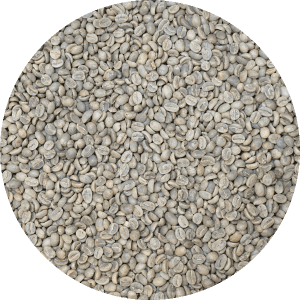
These cooperatives provide producers with valuable logistical support like centralized warehouses to store dried parchment and dry mills where the coffee is prepared for export according to size and quality. Supremo is Colombia’s top export grade, which is not taste related, basically means larger sized beans; contains screen size 17 and 18. This is versus an Excelso grade coffee, which is screen 15/16.
Tasting notes: The aroma of this coffee is very nice; sweet with with a little spice & floral notes. Best at a medium to borderline dark roast. Sweet upfront with a hint of crispness balanced with a stronger toasted walnut/chocolaty undertone. A little hint of acidity at the medium roast point really creates a nicely balanced cup with a broad flavor profile. Touching 2nd crack builds some body and will add some smoky and roasty notes that can compliment the classic Colombian profile.
Roasting Notes:This bean is very versatile when it comes to roasting; good from lighter side of medium to as dark as you want to go. Main recommendation would be in the medium ballpark, smooth and accommodating to almost everyone. Be sure to try different roast points for it will greatly vary what flavors are accentuated.
Honduran Org. SHG EP COMSA Washed Processed
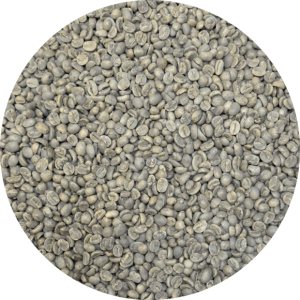
Finca Humana (the Human Farm) is the first thing you will hear about Café Organico Marcala, S.A. (COMSA) if you make your way to visit this cooperative in Marcala, Honduras. The wellbeing of humans is foundational to the COMSA philosophy and educating more than 1,500 producer-members to successfully live in harmony with nature is everywhere at COMSA. It starts with the La Fortaleza, the COMSA biodynamic demonstration farm where the focus of transferring knowledge takes place through week- long seminars called Pata de Chucho (pawprints left by a stray dog), which aptly reveals COMSA’s dogged exploration for human productivity in harmony with nature.
The trailblazing ideas for using organic matter to productively cultivate high quality coffee is only a sliver of what COMSA teaches about the power of nature through the Finca Humana philosophy. COMSA dedicates significant funding from the proceeds of coffee sales to run a cutting-edge international school dedicated to filling children’s minds with possibility and training them to be the future leaders of Finca Humana.
Tasting Notes: This cup is nice and chocolaty, lower acidity and medium bodied. A little sweeter edge to it except for super dark roasts. Besides a chocolaty factor one will get some nutty/caramel/floral like tones at the medium to dark roast points, gives it some nice complimenting depth without being too exotic. We all thought it was at its best right around a full city – smooth without too much of a roasty note and great chocolaty tones.
Roasting Notes: Easy to roast but will roast two-toned. Medium to low chaff. This is an aggregate production coffee which includes multiple strains and pickings. Produces a long first crack and the finished product will have beans in the medium-dark roast range. This is what helps it achieve a full flavored and balanced cup, the slightly lighter beans push out a little floral sweetness, the dark beans provide the rich semi-sweet chocolate tones. An easy and tasty roast point is just touching 2nd crack.
Peru Org. Norandino – Washed Processed
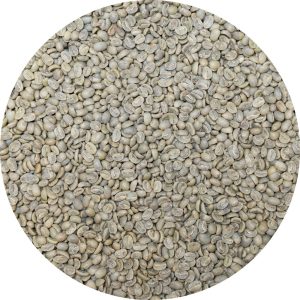
In Peru, the bulk of production comes from small farms owned and managed by indigenous people who follow organic farm management practice attuned to their cultural connection with the land. Producers typically cultivate coffee on just a few acres of land intercropped with shade trees, bananas, corn, and beans. They carefully harvest and sort cherries before depulping, fermenting, washing, and drying the coffee using their own micro-mills. Simultaneously, cooperatives carry out activities that often go unnoticed but are crucial for small producers. These cooperatives are often divided into smaller locally run organizations, larger regional organizations, and even larger umbrella organizations.
The local cooperatives focus on training producers in best organic practices and invest in basic infrastructure needs like road improvements and establishing local warehouses. The regional cooperatives focus on creating credit for producers and investing in social programs on a larger and more impactful scale, using the collective resources generated from the sale of coffee. Environmental training programs, healthcare initiatives, life insurance, and educational opportunities are just some of the ways these cooperatives strive to improve the quality of life for coffee producers and their families.
Tasting notes: A great daily drinking Peru! Best right around a medium roast but works well from light to dark. It stands out for being a very clean and sweet cup. At lighter roast levels it has some crisp acidity, not over the top but noticeable, gives a quick hit lemon and floral that will balance with nutty and chocolate like darker tones. Small hints of caramel and dried fruit will pop out with a little setup. At medium roast levels, you get more of a smooth easy drinking cup, less acidity with accentuated nutty/chocolate tones, a hint of spice in the aftertaste, provides the best balance of light/dark tones. Darker roasts are a little flat and roasty, but on the more neutral side, classic darker roast beans: smooth, rich and on the roasty chocolate side of things with a little nuttiness in the aftertaste.
Roasting notes: An easy coffee to roast, very forgiving and tasty from light to dark. It has medium to low chaff levels and roasts pretty even. If you want to highlight its acidity more, lighter and quicker roasts are the way to go, just make sure everything gets through first crack or risk some grassy peanut like notes. For daily drinking, a medium roast is best, smooth and rich with a sweet edge. Bolder coffee fans, touching or just into second crack gives a clean and classic darker roast cup profile.
Papua New Guinea Org. Siane Chimbu
This is wild wild west PNG coffee versus the Sigri and Kimel which are nice traditional estate models (although still wilder than most farms we would usually think of). Basically, coffee cherries funnel in every day to these operations, farmers and family members pick the cherry from everywhere they can – parks, natural areas, villages, small farms etc… They then bring the cherry to a centralized processing center, who judges the quality of the beans and purchases them assuming the quality is on par. Holds a little different cup profile than the estate coffees but wonderful in its own regard.
This coffee is sourced from farms organized around the Siane Organic Agriculture Cooperative (SOAC) located in the Chuave district within the province of Chimbu, Papua New Guinea. SOAC accesses the international coffee markets for farmers, creating greater earning capacity from direct trade relationships. SOAC also assist farmers with financing, coffee quality improvement, organic certification, and community based projects that promote gender equality and education.
Simbu, officially spelled Chimbu, is a Highlands Region province in Papua New Guinea. The province has an area of 6,112 km² and the capital of the province is Kundiawa. Mount Wilhelm (4509m), the tallest mountain in Papua New Guinea, is on the northern border of Simbu. Simbu in the local dialect really means Sipuuuu, which means “thank you”. Simbu is located in the central highlands cordillera of Papua New Guinea. It shares geographic and political boundaries with five provinces: Jiwaka, Eastern Highlands, Southern Highlands, Gulf and Madang. It is a significant source of organically produced coffee.
To learn more about PNG’s unusual coffee industry, check out our recent blog article “The Wild West of Coffee Production.”
Tasting Notes: The cup is best from medium to dark roasts. Medium bodied, lower acidity and rich. A little hint of acidity upfront which leaves a little hint of caramel/floral at the lighter roast points but can risk a bit of earthiness. Anything even into the medium roast range is pretty chocolaty and smooth with just a pinch of a spice note. Darker roasts get a bit fuller bodied and roasty with some nice smoky accents.
Roasting Notes: Easy to roast, a nice processing batch. Roasts fairly even and is tasty at a little fuller roast points. For a milder everyday drinker, a nice stronger medium roast (a little before or touching 2nd crack) is good. Darker roasts (into 2nd crack) get bolder and a little more semi-sweet chocolaty but the roasty notes compliment the cup and darker roast fans will love it.
This lot is coming from high-altitudes in the Guji Zone (Oromia), sun-dried, and sourced from smallholder farmers and/or private estates at 1800–2200 meters above sea level, featuring local landraces/heirloom varieties and vertosol soils. Guji is located in a remote and heavily forested area where many coffee communities start at around 2000 meters and cultivate upwards from there; the Guji people (part of the Oromo nation) have historically organized themselves to reduce mining and logging pressures and preserve the forest canopy. As a Grade 3 Natural, it is typically assembled as a regional blend: these coffees can come from central processing sites, large estates, or a combination where smallholder farmers (“outgrowers”) sell cherry to estates that process on-site.
The Grade 3 designation indicates a meticulous selection process, separating out coffees unsuitable for this lot. This combination results in natural coffees that taste very good and are quite clean. Buyers at this level typically find them to be of very good quality, generally less “explosive” than a Grade 1, but offering great value for the price. These beans are received throughout the harvest season, sorted by ripeness, and spread in a single layer on raised beds to sun-dry. A long drying period of 3–6 weeks is reported, depending on the weather, resulting in a final moisture content of around 11.5% in the dried fruit. The coffee is then milled locally and transported to Addis Ababa, where color sorting and repeated rounds of hand-sorting are used to finalize the export grade.
Tasting Notes: A fresh and great tasting classic Ethiopian! This is not a super fruity natural, would be considered a darker toned, lower acidity, chocolaty cup. One can tell its natural processed roots with its sweetness and thickness and its Ethiopian roots with highlights of spice & fruity/floral notes throughout the roast range. Best served in the light to medium roast range for drip brew for it will show its best balance and promote a hint of fruity/floral. Turns into a chocolate bomb at the darker roasts, more on the dark chocolate side, which would work wonderfully for espresso or cold brew. Lighter roasts have a pinch of citric acidity and wonderful aromatics, hints of red fruit that balance with a bit of semi-nutty tea like spice.
Roasting Notes: Natural processed with good prep on it, a fairly easy bean to roast. A bit higher chaff and one will notice a little two toned roasting but being tasty from light to dark, should not be a problem getting a tasty cup. Recommend starting at a nice medium roast, if you don’t like acidic and floral, error a little darker, if you love fruity floral, error a little lighter. A little longer setup really smooths out the cup, can be a little more extreme 1-2 days after roasting.


Reviews
There are no reviews yet.